|
Theories about plant community composition in semiarid
environments focus on the relative proportions of herbaceous and
woody plant biomass at a site. These models focus on one or the
other of two fundamentally different concepts:
- Differences
between two or more relatively undisturbed sites are a
function of differences in climate and/or soil profile.
- The same
site can change over time due to disturbance.
The first
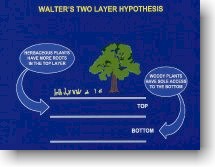
conceptual model, proposed by Walter (1971), focuses on vertical
heterogeneity in soil water content. Two soil layers are
differentiated on the basis of differences in root distributions
of woody and herbaceous plants. Herbaceous plants are assumed to
be much more efficient at utilizing shallow soil moisture, while
woody plants are assumed to relatively sole access to the deeper
layer. The ratio of herbaceous to woody biomass is assumed to be a
function of the ratio of soil water content in the upper to lower
soil layers. For a given soil profile and climate only one ratio
occurs.
The second
conceptual model, proposed by Schlesinger et al. (1990) for
desertification, focuses on horizontal heterogeneity in soil water
content between canopy and intercanopy patches that results from
disturbance. The model assumes that land-use disturbances cause
reductions in herbaceous vegetation; that in conjunction with the
reduction in herbaceous vegetation, intercanopy soils become
compacted; that both these phenomena lead to an increase in runoff
from intercanopy areas; and that woody plants effectively use the
extra water that runs off into intercanopy areas.
We developed
a model that unifies these two conceptual models by relaxing two
assumptions of Walter's model (Breshears and Barnes 1999).
- Soil
moisture varies horizontally between canopy and intercanopy
patches, not only due to land-use disturbance (as assumed by
Schlesinger et al.) but also due the physical nature of the
canopy itself.
- While
woody plants generally obtain soil moisture from deeper depths
than herbaceous plants, woody plants are also differentiated
on the basis of those that extract a substantial proportion of
their moisture from shallower vs. deeper soil depths.
Hence, our
model recognizes four soil compartments (upper canopy, upper
intercanopy, lower canopy, and lower intercanopy) and three plant
functional types (herbaceous, shallow-extracting woody, and
deeper-extracting woody).
By relaxing
the above two assumptions, our model is able to integrate three
key concepts in semiarid ecology:
- The
proportion of woody cover generally increases as soil water in
the deeper layer increases (Walter's two-layer hypothesis for
the coexistence of herbaceous and woody plants).
- Land use
practices that cause a reduction in herbaceous vegetation and
compaction of intercanopy soils lead to a long-term increase
in the proportion of woody plants (Schlesinger et al.'s
concept, or more generally, that at a given site multiple
combinations in the proportions of herbaceous and woody plant
biomass are possible).
- Changes
in the ratios of herbaceous to woody plant biomass exhibit
complex behavior (changes can happen quickly and are not
directly reversible without intensive management).
This
integration results because our model assumes an interdependence
between soil water heterogeneity and plant community composition:
soil water heterogeneity constrains plant community composition,
which in turn modifies soil water heterogeneity.
Our model,
which incorporates concepts about canopy and intercanopy patches
as functional units, provides an integrated picture of both
dimensions of soil water heterogeneity—horizontal and
vertical—and the interdependence between that heterogeneity and
plant community composition. The model can be applied to provide
insight into plant community dynamics for sites along the
grassland-forest continuum and the individual and combined effects
of climate and land use on plant communities.
Related
Publications
Breshears,
D. D., and F. J. Barnes. 1999. Interrelationships between plant
functional types and soil moisture heterogeneity for semiarid
landscapes within the grassland/forest continuum: a unified
conceptual model. Landscape Ecology 15: in press.
Schlesinger,
W. H., J. F. Reynolds, G. L. Cunningham, L. F. Huenneke, W. M.
Jarrell, R. A. Virginia, and W. G. Whitford. 1990. Biological
feedbacks in global desertification. Science 247: 1043-1048.
Walter, H.
1971. Ecology of Tropical and Subtropical Vegetation. Edinburgh:
Oliver and Boyd.
|