Research Projects

Introduction of Vegetable Grafting to Enhance Sustainability of US Fruiting Vegetable Production
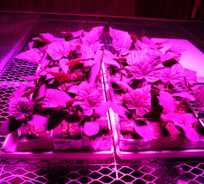
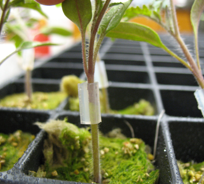
Grafting of vegetable seedlings is a unique horticultural technology practiced for many years in East Asia to overcome issues associated with intensive cultivation using limited arable land. To use this technology widely in North American fresh vegetable production, more information and locally collected scientific and technical data are needed. An issue unique to the U.S. is the large number of seedlings needed in a single shipment particularly for large scale open-field production. Semi- or fully-automated grafting robots were invented by several agricultural machine industries in 1990s, yet the models available in the U.S are limited. The lack of flexibility (e.g., in tray size and plant size) of the existing robots also limits their adaptation to U.S. propagators. Strategies to resolve these issues include use of highly controlled environment for producing standardized seedlings suitable for automation, introduction of sorting and grafting robots, and better storage techniques. In Kubota Lab, we work on several projects that are believed to be helpful in making this viable technology adoptable in the U.S. We consider that, through grafting and transplant production, CEA technology can contribute to more traditional open field crop production in North America.
Application of LED Lighting in Greenhouse Specialty Crop Production
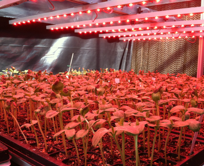
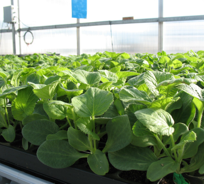
Greenhouse hydroponic vegetable seedling production in both northern and southern states uses supplemental photosynthetic lighting. According to our recent stakeholder meeting, propagators are generally interested in replacing supplemental photosynthetic lighting (HIDs) with LEDs as a new technology to enhance productivity and sustainability. However, it was noticed that there was limited information on the best design (color ratios, fixture design and size) and practice (distance and application time of day) that are likely to achieve expected outcomes (reduced resource use and light pollution without reducing plant quality and yields). Several supplemental LED lamps are already commercially available and more models and suppliers will be introduced in this potentially growing market of LEDs.
To address the issue, part of a multi-state and trans-disciplinary team with researchers in Purdue, Michigan State, and Rutgers University, Kubota lab is working on several applications of LED lighting in greenhouse.
In addition, Kubota lab has been working on supplemental lighting technology to improve the greenhouse product quality, especially health promoting nutritional quality, since light quality is know as a factor affecting plant growth, development and secondary metabolites.
Hydroponic Strawberry Production
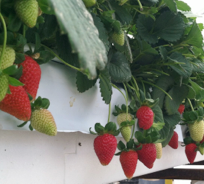
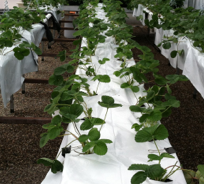
Controlled environment agriculture (CEA) can provide opportunities to produce strawberry fruit in a sustainable manner. Both aerial and root zone environments can be controlled in CEA and maintained in the optimum range to maximize the productivity of strawberry plants. Nutrient solution can be recycled to save water and reduce fertilizer use, making resource use even more efficient. Use of substrate/hydroponics eliminates the necessity of soil fumigation. Greenhouse structures exclude insect pests, reducing or eliminating the necessity of pesticide application. Strawberries are produced commercially in such sustainable ways in greenhouse in places like Japan and Europe. However the US has largely been left behind in this endeavor for strawberry, mainly due to the lack of practical information, appropriate education, and technology to support greenhouse hydroponic strawberry production.
The goal of our project is to establish sustainable off-season hydroponic strawberry production in the desert southwest where there currently is very limited production of strawberry but there are strong greenhouse industries that successfully conduct year-round production of high quality tomato yet experience ever-increasing pressure for product diversification due to the aggressive price competition for the current products (i.e., tomato).
iCEA -- Urban Food Production and Plant Factories
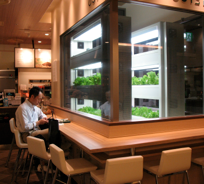
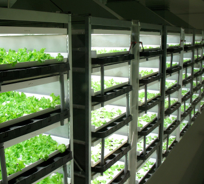
Urban food production and plant factories (iCEA) are attracting interest of growers, city planners and entrepreneurs. These types of production facilities are adopted widely in Asian countries where cultivation of vegetables has been historically intensive and there is strong government support to promote this unique industry sector. There are a number of closed warehouse-type iCEA facilities serving local markets and nearby metropolitan areas. Crops include leafy vegetables, herbs, and various transplants. One of the challenges of iCEA is obviously the high production costs as well as the limitation of crops to which iCEA can easily apply. Clearly iCEA applications would not replace the greenhouse, and it would have to target niche markets, co-existing with greenhouses and open-fields. New businesses are expanding urban food production to restaurants, business offices, local community buildings and nursing homes. Plants and plant production systems can serve as an important architectural and psychologically functioning component in addition to its original role of producing food. There is increasing interest in North America and several facilities are now in commercial operation. Kubota Lab is evaluating various iCEA technologies to introduce effectively in US urban food production.
PAC -- Photoautotrophic Arabidopsis Culture: Development of In Vitro Experimental Platform to Assure Normal Plant Physiology
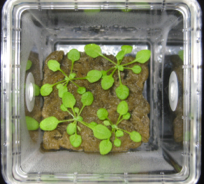
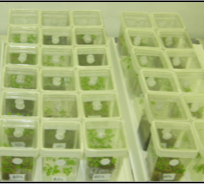
Plant tissue culture serves both as a propagation and a research tool to grow small plants under aseptic conditions. Plant biological studies using model plant species (i.e., Arabidopsis spp.) sometimes employ tissue culture as the research platform to test the biological hypothesis of interest. Especially for Arabidopsis spp., tissue culture has been employed as a preferable contained experimental system assuring uniform growth, presumably due to the environmentally sensitive nature of Arabidopsis plants, despite that in-vitro environments are different from growth chamber or greenhouse environmental conditions. To address this issue, we demonstrated photoautotrophic Arabidopsis culture (PAC) using A. thaliana (Col-0), a widely used genotype. Photoautotrophic plants developed more normal morphology and greener leaves with more trichomes than conventional ones. PAC will be advantageous when one wants to test transgenic lines or materials that are difficult to test in greenhouse. A user-friendly PAC manual was developed based on this demonstration. Methodological ideas to test environmental factors such as humidity and CO2 concentration will be presented. This controlled environment culture platform that allows whole-plant experimentation using transgenic or tissue culture materials in vitro will be a major contribution, with increasing demand for translational plant biology using other crop species beyond Arabidopsis.